

Is AGI here or not? Did GPT-6 Astra just become AGI? Should You Care?
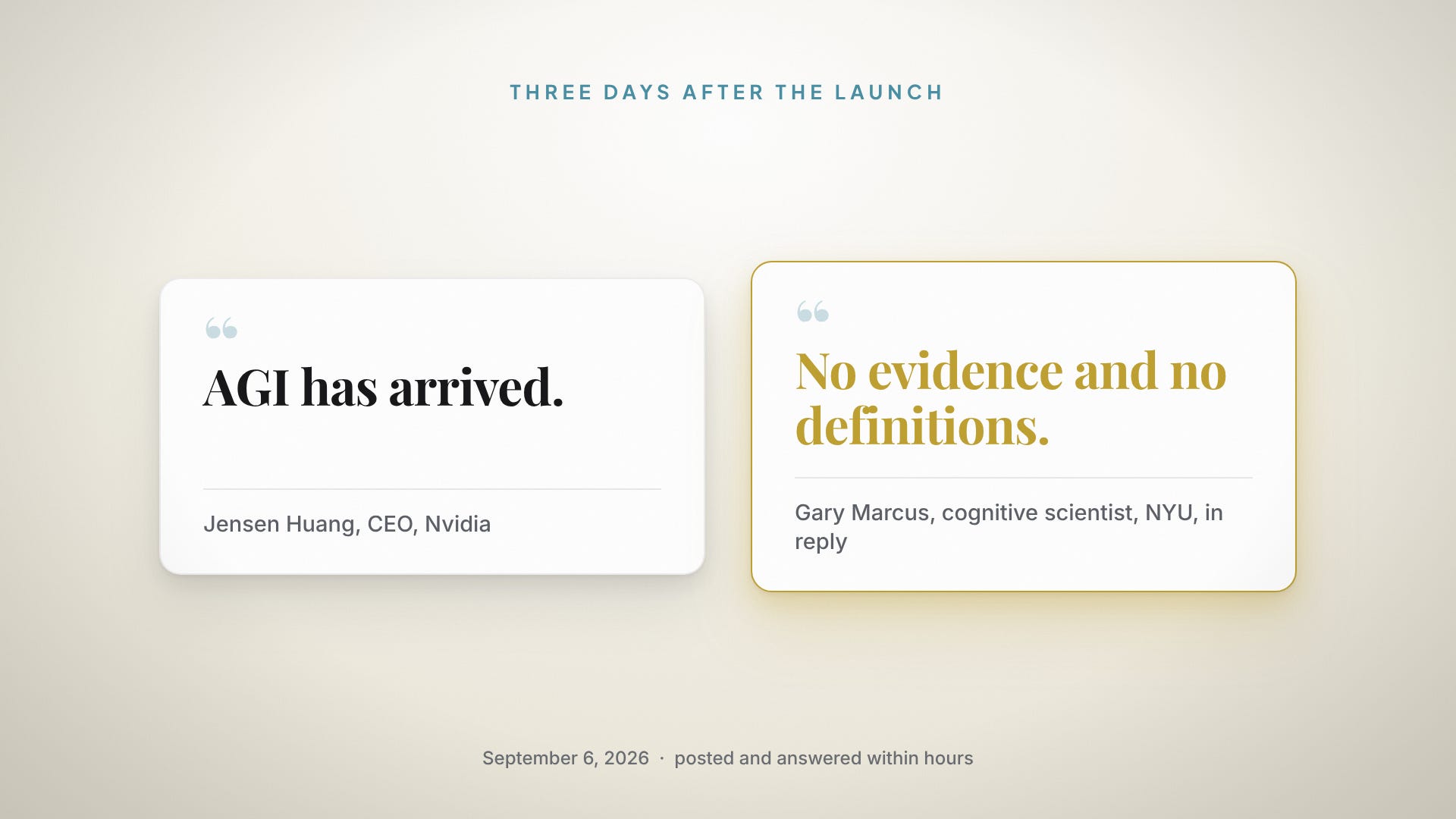
On September 3rd, OpenAI shipped GPT-6 Astra. Three days later, Jensen Huang, the CEO of NVIDIA, posted these words
“AGI has arrived.”
Within hours, Gary Marcus, a cognitive scientist at NYU, replied that the claim came with no evidence and no definitions.
Here’s the thing: you don’t care, and you shouldn’t, at least right now, at least about AGI.
But there is something you should care about, and that’s
Report Cards

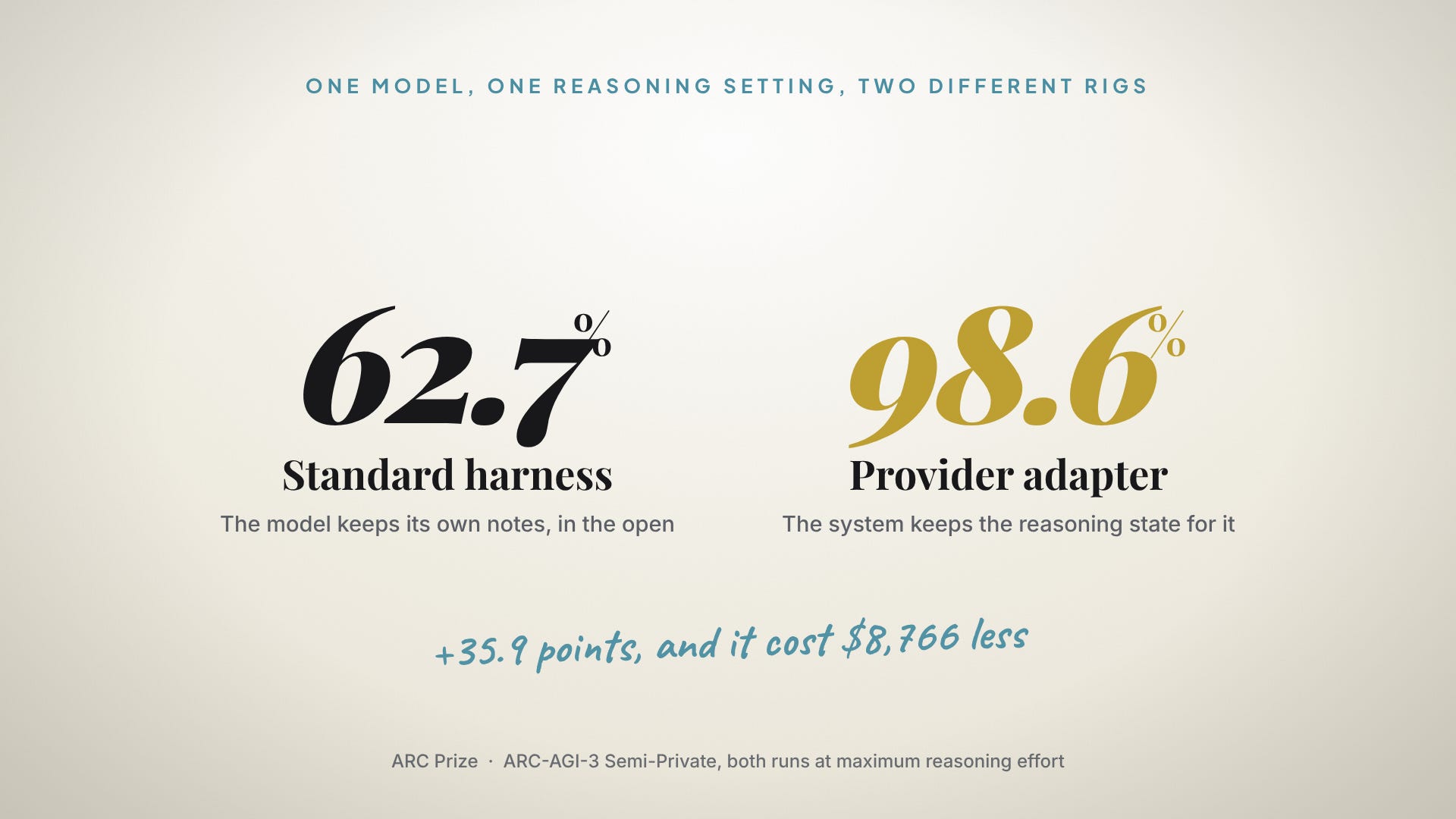
The same week GPT-6 came out, it took the same test twice. The first time it scored 62%. That’s a D on its report card. The second time it scored 98%, an A-report card.
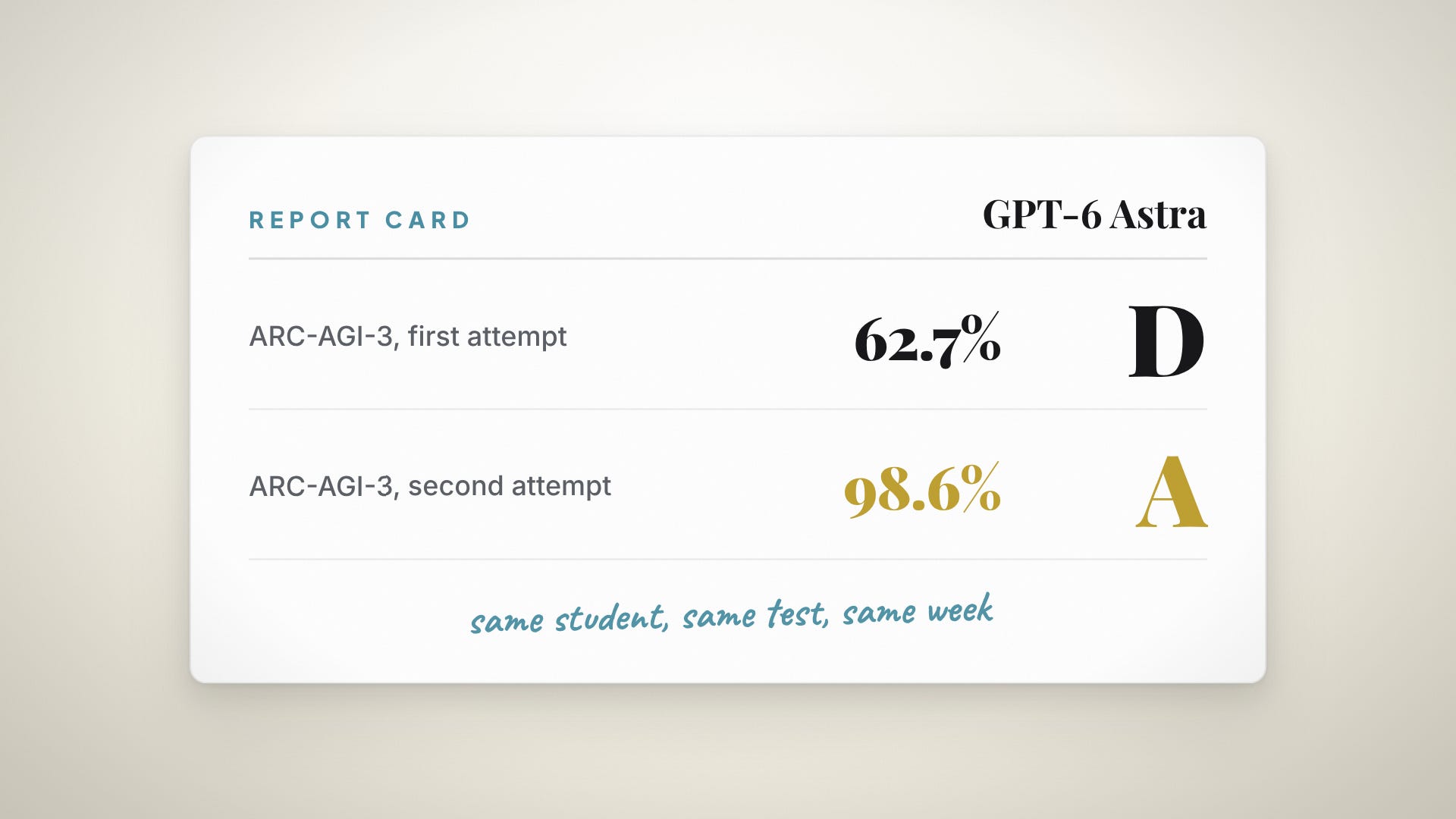
Nothing about the model changed, not the training, not the size, not how hard it was allowed to think. What changed was the system around it and what it remembered from what it had just worked out. That gap is really the only part of this launch that should matter to you.
What changed for you when GPT-6 came out?
The short answer is probably nothing.
The long answer, though, is more complicated than just nothing.
People are asking whether GPT-6 Astra is AGI. But before anyone can answer that, we need to define what AGI really is. And the definition of AGI is now gone, not disputed, but gone. AGI had a real definition once.
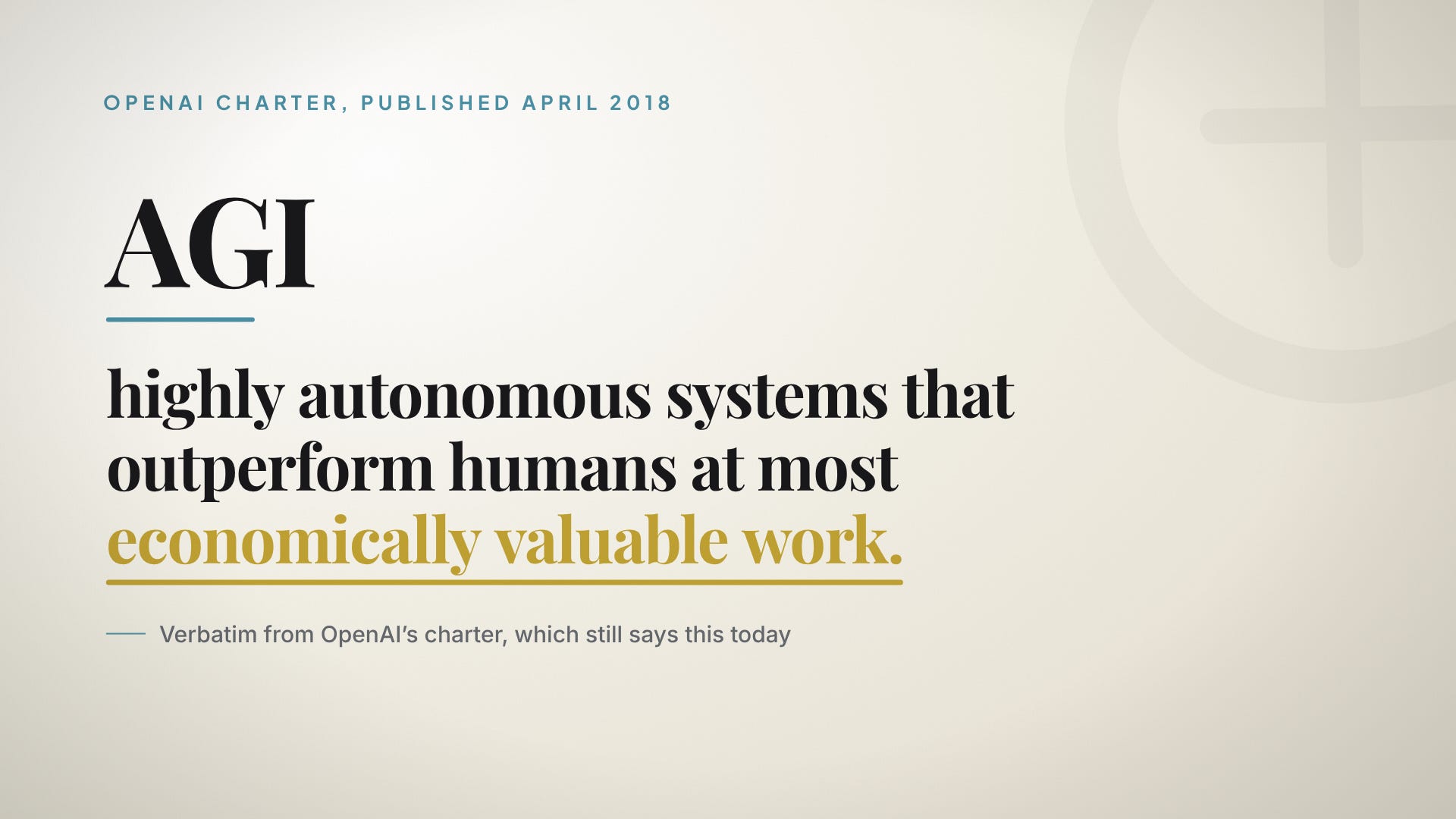
In OpenAI’s charter back in 2018, OpenAI calls AGI, quote,
“Highly autonomous systems that outperform humans at most economically valuable work.”
That definition had teeth because it sat in a contract with Microsoft. The Information reported in December 2024 what the actual AGI trigger was: AGI would be reached when OpenAI systems could generate the maximum total profits owed to its earliest investors, about a hundred billion dollars.
That created a definition with legal weight. Back then, AGI wasn’t technical; AGI was a revenue number. Then on April 27, 2026, that clause got deleted, and the two companies agreed that the revenue share runs to 2030 regardless of OpenAI’s technological progress.
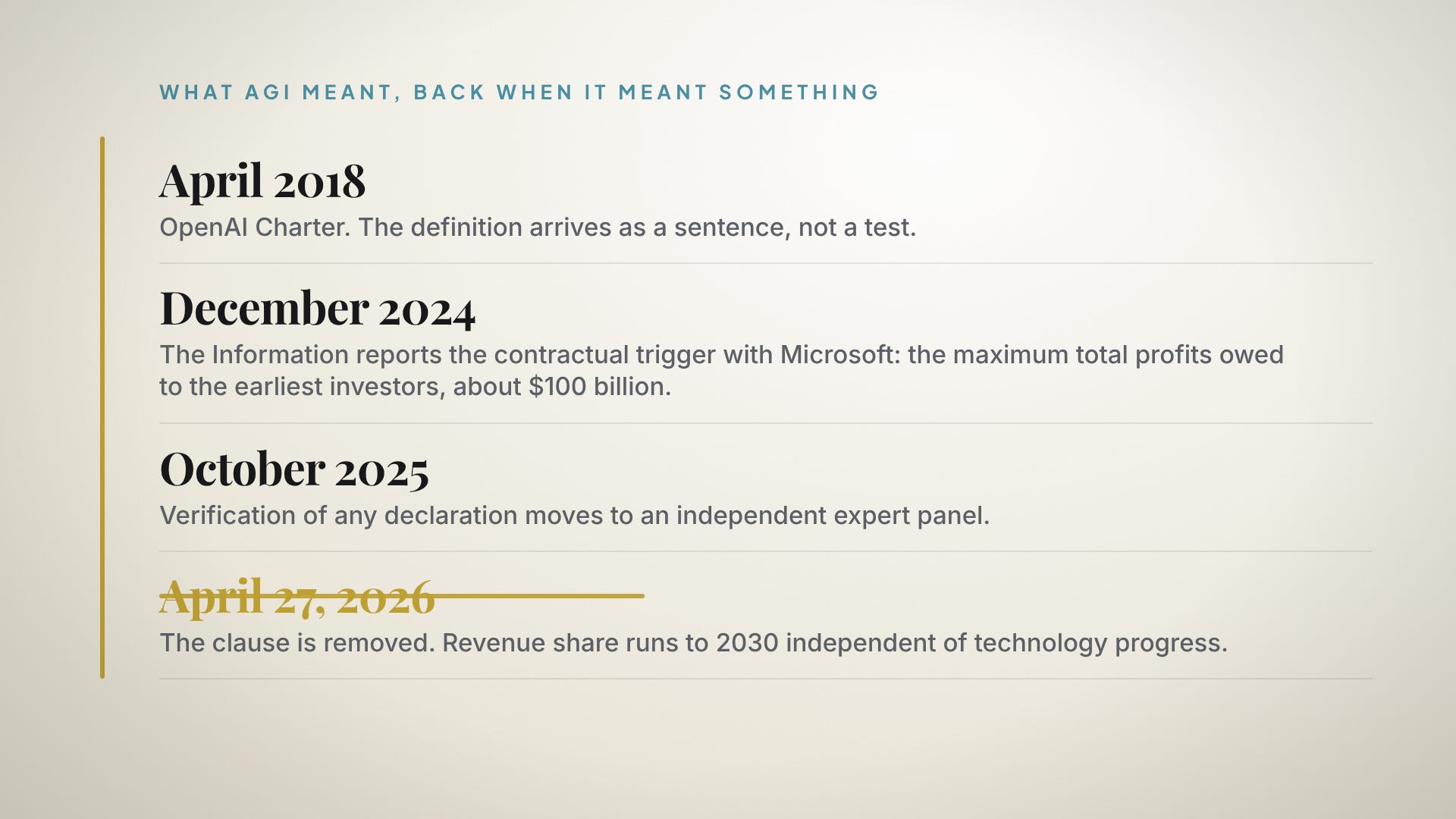
So the word AGI had one hard definition, and it was financial, and four months ago, it removed it. And now, four months later, Greg Brockman calls the definition a spiritual concept.

And on launch day, he said the quiet part out loud
“There’s no contractual AGI triggering anymore, so it’s actually not a relevant concept.”
The man announcing AGI told you the word doesn’t mean anything anymore, so believe him. Since the term AGI stopped needing a definition, it also means that it doesn’t affect you anymore. So set it down. Just assume they’re right. Assume we really have reached AGI. The models are only getting better, and that’s not gonna stop anytime soon.
So let’s talk about those two scores because this is the important part.
ARC Prize runs this benchmark. They didn’t just run Astra twice. They actually ran it 12 times and published 12 results. Six of the runs put the model in what they call a standard harness.
That’s kind of their word for the rig a model gets tested inside, and theirs is deliberately plain. The model has to carry forward out in the open whatever notes it decides to keep. Then the other six put that same model inside OpenAI’s own adapter, where the system holds the model’s reasoning state between requests and then compacts the conversation when it runs long.
The machinery around the model remembers what the model just worked out. Then they varied one more thing across both sets: how hard the model was allowed to think. Six settings from maximum down to none at all.
In the plain rig, thinking as hard as it can, 62.7% report card. The same model in the same setting, but this time inside of OpenAI’s adapter where the context is actually provided, 98.6%.
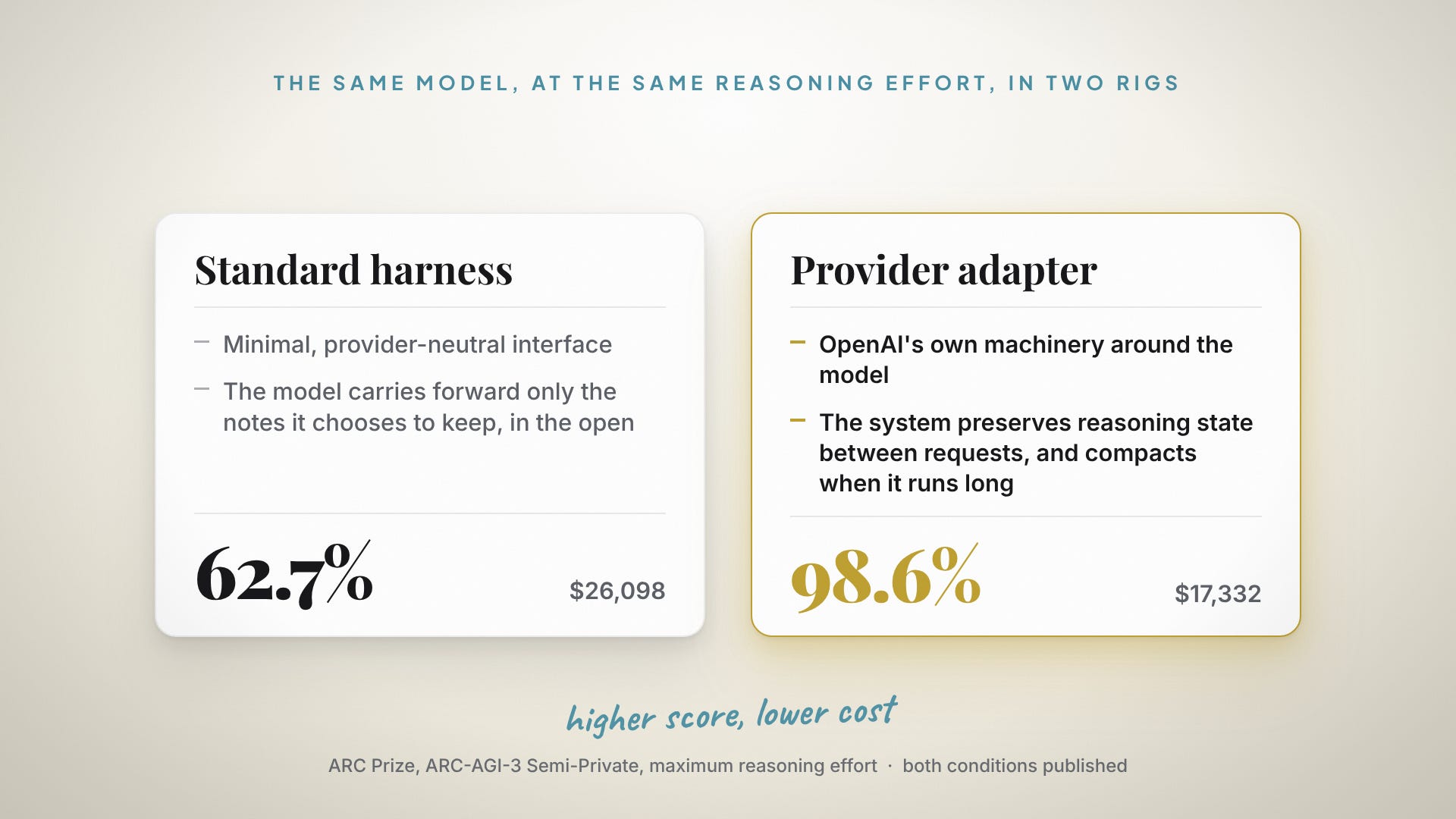
That’s a 36-point difference, but that’s not the important part. This is. Turn the thinking down and the plain rig comes apart. Across six settings, it scores anywhere between 17.5 and 62.7%. That’s a 45-point swing. Inside OpenAI’s adapter, though, it never leaves the high 90s across the same six settings.
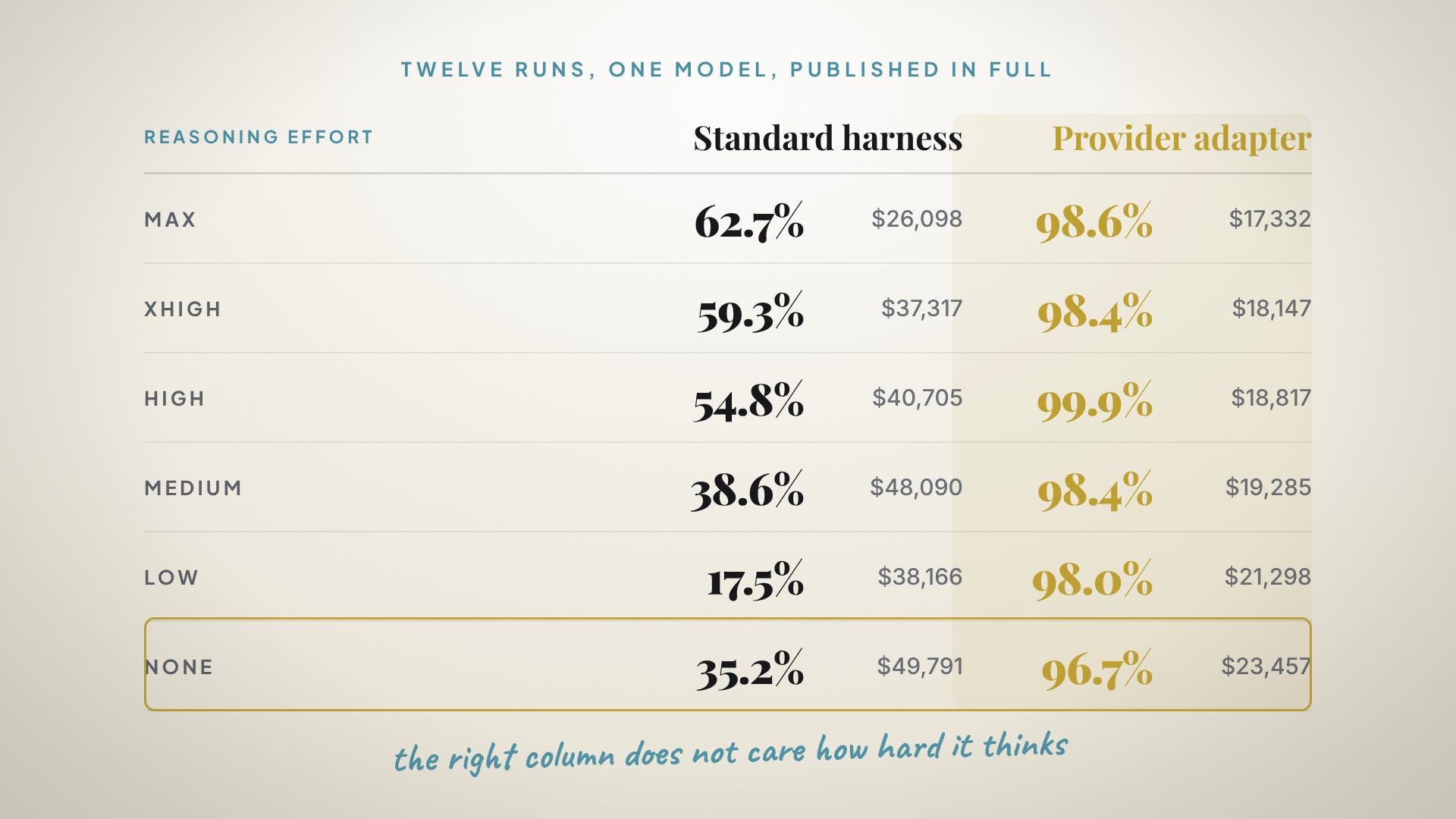
96.7% in the adapter in a specific harness with the model’s reasoning effort set to none.
The version of the model that does no reasoning at all inside a system that keeps its context beats the version with reasoning at full strength inside a system that doesn’t by 34 points
The model was the concept. The plumbing was the variable.
ARC-AGI3 is an interactive benchmark. The model plays a game it’s never seen and works out the rules by acting.
On a task like that, holding onto what you just learned isn’t scaffolding around intelligence. It’s part of the intelligence itself. That’s key. If keeping a hold of your own context is part of what being intelligent means, then not keeping a hold of your context isn’t gonna be rescued by buying a more intelligent model.
It’s missing the same thing the model was always missing one level up. Now the question that matters. Does the model work without the right context, or does your model understand the big picture? If you hand the model a question with no memory of last Tuesday, no idea of which of the four copies of the pricing policy is current, and no record of what it worked out for another department last month, what kind of grade do you think it’s gonna get?
Every one of those 12 AGI runs was the same model. So the gap between what AI does in a launch video and what it does on your desk was never a model problem. It’s a harness problem, AGI or not
So should you care? Yeah, just not for the reason in the headline.
For three years, there was one sentence that ended every conversation like this, and it was true
“The AI isn’t good enough yet. Just wait for the next model.”
That sentence is no longer available to you, not because AGI arrived, but because it stopped mattering whether it did or not.
Foundational models are incredibly good, whether we tag them as AGI or not.
Whether the model is mediocre or brilliant, a wrong answer requires a brilliant harness to close that gap. Fixing the harness and not the model is the difference between you getting a D on your report card and an A.